


DigiWELL is entering the second half of the project. On 1 and 2 October, researchers from its individual teams and partner institutions will therefore meet at the OU City Campus to present how their research has progressed over more than two years.
 3 min.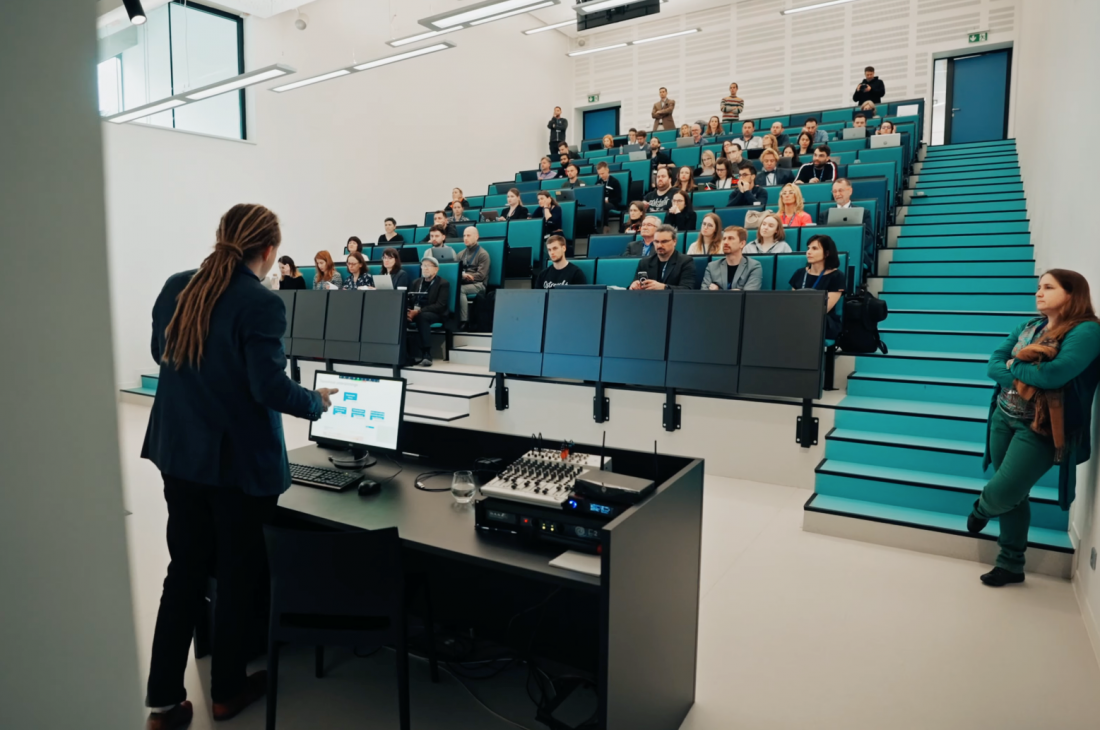

The two-day programme will offer a diverse range of topics. The common denominator will be the question of how technologies are becoming part of our everyday lives and how they can help researchers better understand their impacts.
On Thursday morning, attention will focus on how modern technologies are transforming research into health and human behaviour. Lenka Knapová, for example, will address the seemingly simple question of why deciding to be more physically active is sometimes not enough in her presentation From Momentary Intentions to Action: Psychological and Environmental Influences on the Physical Activity Intention–Behavior Relationship.
From physical activity, the programme will also move on to nutrition. In his presentation Automated Dietary Quality Assessment for Personalised Nutritional Feedback in Free-Living Conditions, Martin Šašinka will introduce the possibilities of automated assessment of dietary quality in everyday life. The aim is to use the data collected to provide personalised feedback that can help people better understand their own eating habits and potentially change them.
Technologies, however, are not only the subject of research. Increasingly, they are also becoming a research tool. Jiří Čeněk will demonstrate the possibilities of eye-tracking, or tracking eye movements, in the social sciences. The method can help researchers determine what people pay attention to or how they process visual stimuli.
In the afternoon, attention will shift to children and adolescents. Libor Juhaňák will focus on increasingly common mobile phone bans and ask whether they really represent a simple solution or whether such measures also bring less obvious side effects.
Researchers will also examine which apps adolescents use, what they actually do on them, and how different ways of using digital media relate to their overall wellbeing.
On the second day, part of the programme will move from presenting results to sharing them in practice. The workshop entitled UPOL Challenge accepted will offer a behind-the-scenes look at science communication. Its topic will be organising a press conference directly as part of a scientific conference – a practical demonstration of how to bring research findings from the academic environment to the media and the wider public.
Another workshop, aimed directly at secondary school students, bears the fitting title Prostor pro porozumění. It will bring together ten Roma and ten non-Roma students who, following an introductory theoretical section, will let their imaginations run free during the Speed socks activity. Through shared discussion and creative work, they will try to step outside established categories. The aim of the workshop is to foster mutual understanding, break down prejudices and create new connections between young people.
At the same time, a poster session will present additional projects and ongoing DigiWELL research. The topics range from the relationship between sleep and physical activity to the digitalisation of Czech labour offices and a preliminary study on the use of the robot Robin in a retirement home.
After the practical part, the programme will return once again to research presentations. This time, the focus will be on areas in which technologies are entering highly personal and sensitive situations. Increasingly, they are influencing elder care, the choice of a doctor, psychotherapy, or the ways in which we maintain relationships with other people.
Xingyue Su, for example, will show what such a transformation looks like in practice. In the study AI Integration in Institutional Elder Care: A Qualitative Study of Care Workers’ Experiences in an Advanced Smart Nursing Home in Shanghai, she examines the experiences of employees at a technologically advanced nursing home in Shanghai.
The full programme is available here.
DigiWELL Impact Forum 2026 will take place on 1–2 October 2026 at the City Campus of the University of Ostrava. The programme will include expert presentations, discussions, workshops, a poster session and opportunities for networking. The main topics will be digital wellbeing, mHealth, wearables and EMA, health and physical activity, the digital wellbeing of children and adolescents, artificial intelligence, ageing and care. The conference will be held in English and Czech and is intended for researchers, students, project partners and others interested in digital wellbeing.